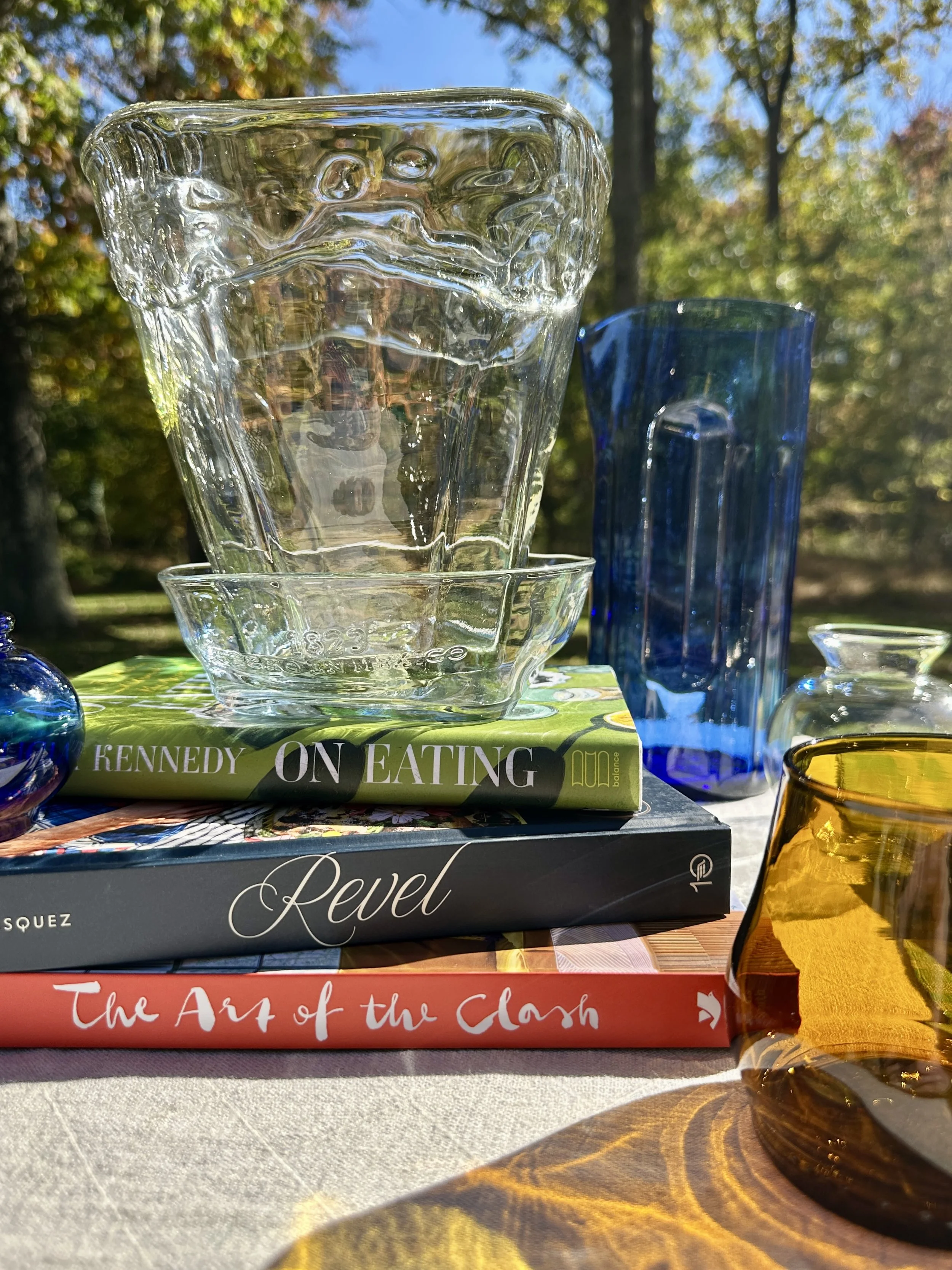
The Philadelphia-based Remark Glass, founded in 2016 by Danielle Ruttenberg and Rebecca Davies, is part of the Tomato Tomato x Central Stem holiday shop collaboration. They also have a nonprofit, Bottle Underground, that collects bottles and jars from local businesses and community members, and a portion of that is selected for Remark Glass to be turned into a long-lasting object. Danielle told us about the thinking behind their business and its ideal circular economy.

“It’s a readily available resource, and at the same time, the art glass studios were having supply problems, so we were like, ‘Why don’t we try to make this work better?’”
Remark Glass started as a very boutique design firm working exclusively in recycled glass, and that naturally evolved into a community-driven project because what we were looking to do is create a circular environment in which the community members and bars and restaurants were contributing their waste glass, and then we were reinventing that into different wares that could be used in those same places.
So whether that's a wedding gift that becomes part of your daily life in your home, or lighting that gets installed in a new bar restaurant, or just even the glassware that's in a bar restaurant. Overall, it's a nice circular model that really relies heavily on a close circular economy, meaning that we're looking at regionality—the geography really lends to the glass getting from point A to point B and then distributing back out probably on a larger footprint because we do sell across the country and occasionally across the globe, but more the story is keeping it circular and local.
I started as a glass blower. I went to Tyler School of Art, Temple University's art school, and I found the material really fascinating. I found the forever moldability and the heat aspect very enticing, and I stayed involved in glass after I left school, more so on a designer and a fabricator level. I spent years doing very involved, high-end installations, and there is a lot of waste in the process.
There were a couple of things that added to looking to bottle glass as a source material, and it's there were a lot of things happening all at once that made it make sense: It's a readily available resource, and at the same time, the art glass studios were having supply problems, so we were like, "Why don't we try to make this work better?”
It's something that's been tried before, but not to a level of repeatability, and also, from a personal standpoint, doing work that I was solely responsible for and kind of like piecemeal, like larger jobs. I was at a point in my life. I was like, how does it make sense for us to collaborate and team up to support one another? Becky and I, myself, my business partner, we are growing into this industry that's not necessarily family-friendly, to be able to be parents and grow a business at the same time.
One of those was organic. Like, my life is changing, and I need to think about sustainability from that standpoint in a different way, but also just like the excitement about a material that doesn't lend itself to the arts as well, and really look at it as a design challenge.