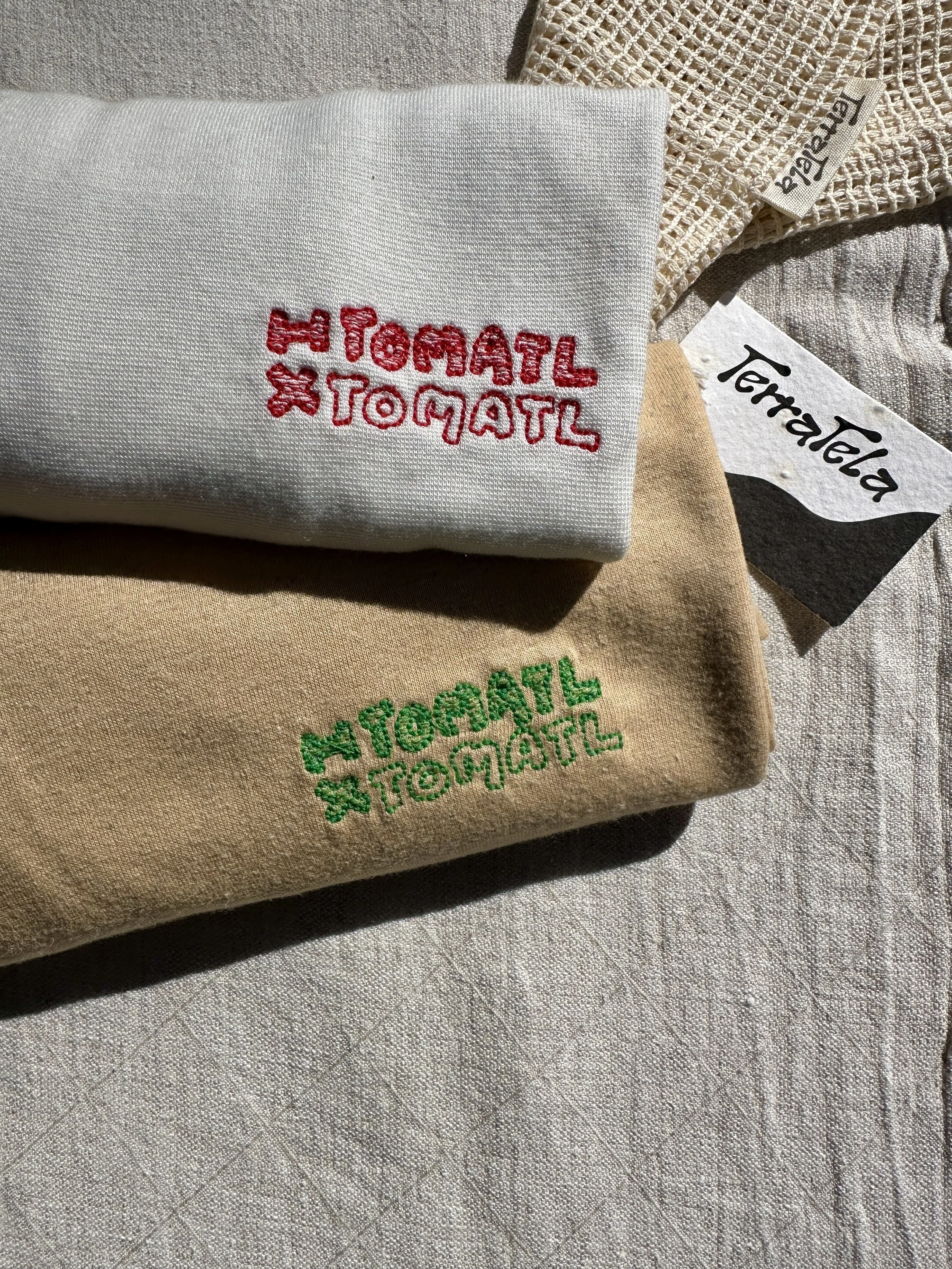
Did you know that milk and soy fibers are not a new anti-food waste fad but centuries-old? “Henry Ford was actually really into soy fibers and had some suits made like 100 years ago out of soy fibers,” Natalia Burakowska of Terratela, which she co-founded with her chef husband Filippo, tells me. In Italy, there’s a history of fibers made from milk with surprising texture: “It's really silky, but it's still an animal protein, so it has a little bit of warmth and wooliness to it.”
This is the kind of storytelling she is doing with her brand, which is putting out well-made basics designed with fabrics derived from different kinds of food waste—including our very special Tomatl Xitomatl collaboration on milk or soy fiber T-shirts. Here, she introduces us to how she came to this work.
“When we started the project, I also wanted to create clothing that was serving a purpose, besides just more clothes out there. I had started to meet a lot of chef friends from my husband's side of the community, and a lot of them were complaining about the different garments that are available to them.”
My background is in fashion. I've worked in it a long time, but my family are farmers from Poland. So, growing up, I always had no waste in my life. Everything that my mom could use for the garden, in some way, she used. So, when I started working in fashion, I realized how wasteful it was, just beyond.
My partner is in the food industry, and we got to talking. I had started to meet some fiber scientists that are doing some very innovative things within fibers and materials, and so that's kind of how the whole thing started. We saw that they were struggling with selling their products to brands, and so we wanted to create something that was all around those types of fibers and really promoting the story, talking about them, sharing them with people. Because I see that the more people find out about us, that no one knows these fibers exist, and it just feels like it makes so much sense to me to use what's already out there and give it a new life versus you know endlessly having to grow you know fields of cotton and linen and hemp.
Our milk and the soy are coming from our partners in China, and those get processed in the EU after, and then our corn fiber is made in the Middle East with American corn, and that gets processed also in the EU. Our seaweed fibers are coming from Iceland, and those all stay within the EU for the processing. So it really depends, kind of where the majority of the waste is.
When we started the project, I also wanted to create clothing that was serving a purpose, besides just more clothes out there. I had started to meet a lot of chef friends from my husband's side of the community, and a lot of them were complaining about the different garments that are available to them.
I started looking into it because I also feel like you don't know. I guess that also goes to our customers: You don't know what you don't know, and I didn't really know anything about chefwear. It wasn't something that I needed as a consumer, so I didn't know what that was like. When I started looking into it, I noticed a lot of those companies that make chefwear use polyester, which blew my mind because you're in a hot kitchen all day.
I wanted to do something for the cook community, especially because it ties in with our storytelling of the fiber so well, and a lot of chefs I meet, if not pretty much all chefs I meet, have some kind of food waste tied into what they do. We wanted to build garments for them. We started with T-shirts, and we're slowly starting to grow into different types of shirts, pants, and aprons.
I am really amazed by our organic searches. A lot more and more things are popping up for food waste clothes. So hopefully that's us starting a trend.
But one of the things that we do is do pop-ups with restaurants. We work with a chef who already has sort of that ethos within his own restaurant or her own restaurant, and they create little bites or something that is made from food waste.
We have a little pop-up market with our product there. That's how I met Holly. She came to one of our events, and it's a great way for us to bring our community, the chefs to bring their community, and people can just see different ways that different industries are using waste.
That was important to me too because I felt like I always had fashion events, my husband always had food events, and they just kind of stayed in their own industries. And having that crossover and that conversation just opens people's minds up in really fun ways. So we also had Farm to People—they sponsored and gave us the surplus peaches that they had. So I think just like putting this thread through all the elements in the events, a lot of people come from different industries, and it's really fun to get those conversations going.