

‘The World Atlas of Fermented Foods and Drinks’ by Ken Albala
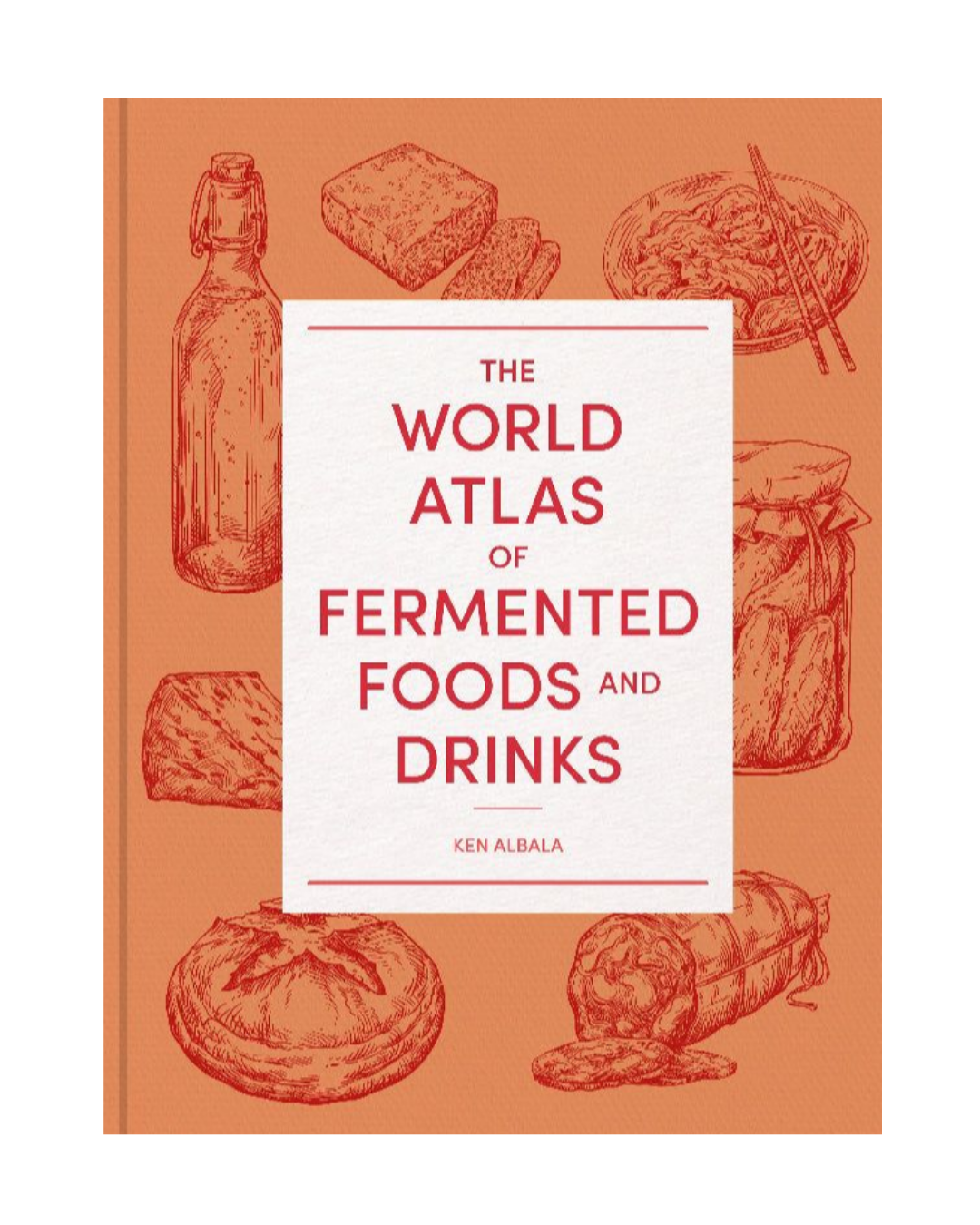
Fermentation as land lies at the heart of Ken Albala’s new book, The World Atlas of Fermented Foods and Drinks. Albala begins this journey in Sub-Saharan Africa, a place often underacknowledged in Western fermentation discourse. He structures the book into twelve global regions and features a range of ferments in each. Most are accompanied by photographs, but all are explored through their histories, cuisines, cultures, and methods.
Most striking, he centers the deep interrelationship between communities, fermentation, climate, and ecology. How injera, a fermented flatbread popular in Ethiopia and Eritrea, uses a drought-resistant grain called teff or how Ash-kardeh, a fermented Persian soup, becomes harder to find as its core ingredient, the wild plant kardeh, grows scarce. Traveling farther, how the pits used to prepare masi, a Polynesian fermented breadfruit paste, are passed down across generations.
Albala animates with specificity the more-than-human life found in these ferments. He discusses which microbes appear and recede at different stages and uses the names of microbial species, Lactobacillus brevis, rather than their genus, Lactobacillus, or type, lactic-acid bacteria.
But this exactitude doesn’t veer into healthism, as Albala fully embraces the sensory delights of fermentation. He writes, “arguably the best way to eat feta is with a wedge of cold watermelon on a hot summer’s day.” Every so often, he enters the text not as an author or historian, but as an eater.
Practitioners, enthusiasts, those curious about fermentation, food, and geography will be sated here. In this Atlas, Albala travels from the land, through the ferment, to the mouth, and back again. He reveals the cyclical nature of cuisine and how, despite varying circumstances, it remains accessible by taste.
Rebecca Echevarria is a New York-based artist and public scholar who explores how food preservation intersects with place and sociality. She teaches in public libraries, screenprints cookbook illustrations onto t-shirts, and hosts Meant to Ferment, a radio show on WGXC 90.7 FM about the fermentation world of the Hudson Valley and beyond.