

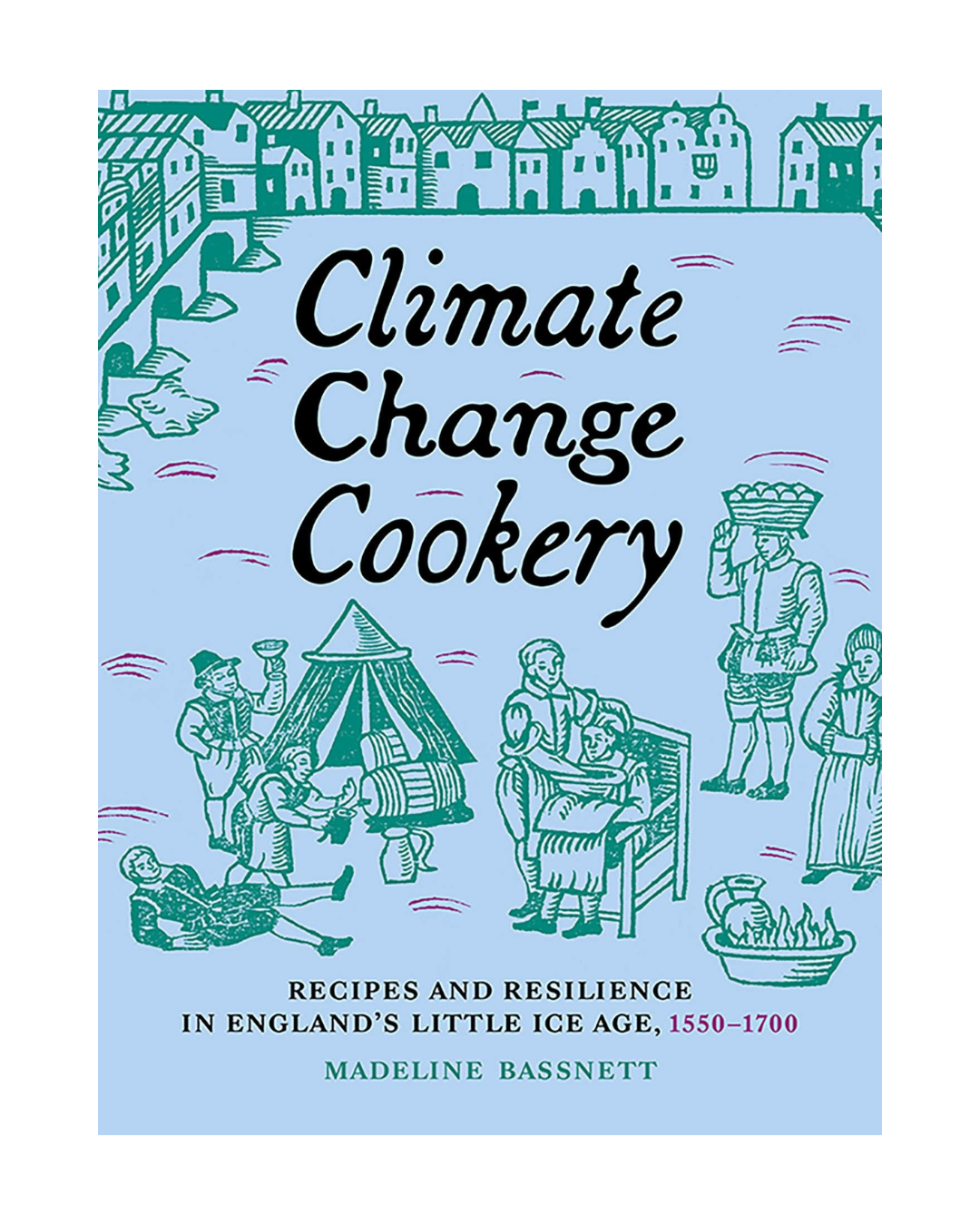
We are living in precedented times, Madeline Bassnett assures us in her new book, Climate Change Cookery: Recipes and Resilience in England's Little Ice Age, 1550–1700 (out December 21 from Concordia University Press). Drawing upon recipe collections, diaries, almanacs, and other written ephemera from the Little Ice Age, Bassnett collates evidence of human adaptability amid a period of climatic cooling, crop failure, hunger, and uncertainty in early modern England. The plunge into archival material is delightful. Seemingly archaic instructions on how to pot a glut of lamprey or run a pin through green apricots embody disparate human responses to precarity—thrift, greed, creativity, overindulgence—that reverberate in the 21st century.
Yet, what are we meant to learn from a prior era of climatic uncertainty defined by subsistence agriculture? Bassnett flits between frames that center the domestic and practical to systemic ills like capitalism, plantation agriculture, and settler colonialism, without always well-tracing the means of that scalar jump. Rather than seriously unpacking climate and recipes’ roles in shaping (or reflecting) human cultures, we often get sweeping, overly moralizing statements. Food preserving is described as “an example of the best and worst of human innovation, in that it responds to and supports us through instability even as it destabilizes our collective futures,” a conclusion that emerges from Bassnett's compelling description of how food preservation—meat and fish in particular—supported extended sea voyages that enabled colonial expansion. A better analysis would try to explain why all food-preserving cultures do not colonize other nations, but England did.
Bassnett succeeds in immersing the reader in the attentiveness of historic cooks, particularly in her chapter on “Seasoning,” where we find instruction on time-sensitive snail harvesting and fruit preservation adaptive to various stages of ripening. Her calls to bring some of this flexibility and responsiveness into modern-day recipe development are appreciated in an era during which AI is being proffered as a means of eliminating the need for kitchen know-how. However, Bassnett’s broader hopes for prompting a reimagining of “our Anthropocene relationships to food and the more-than-human world” might be out of reach for the many home cooks lacking orchards and access to land, and whose food choices remain controlled by a handful of agri-business firms. This critique is not a call for abandoning the recipe as a medium for inciting alternative cultures, but a request to refine our understanding of what power recipes truly hold, and when it is best wielded.
Tara Conway is a political ecologist living in Athens, Georgia.